THE PRODUCTION POSSIBILITY CURVE

Introduction

The production possibility curve (PPC) is a curve which shows the maximum combination of two goods say Good X and Good Y that a country or an individual Can produce given its state of technology and the amount of resources in a given period of time. The Production possibility curve can also be known as the production bouandary/frontière, Opportunity cost curve or transformation curve. In the construction of a PPC, the following assumptions are to be considered.

1. The quantities of available resources are fixed

2. Only two types of goods are being produced and consumed. ie. Consumer goods and Capital goods.

3. The technological state is considered to be constant

4. The economy has reaches the full employment of her resources

5. Resources are sustainable at the margin

How to plot a Production possibility curve

i. Reverse one side of the table and allow the other side. That simple means that one side of the table of values should be in ascending order of value while thé other side should be in descending order.

ii. Adjust the production combination by making the descinding figure to stard with zero. This is so because the X and the Y-axis originate from the origin.

iii. Plot the adjusted combinaisons.

iv. Connect the plotted points with a smoth line begining with one extreme and and ending with the other and this will give the Production possibility curve.

Types of Production possibility curves (PPC)

The Production possibility curve can be braodly splitted into three types which include the following

I. CONCAVE PRODUCTION POSSIBILITY CURVE

The concave PPC is used to illustrate increasing opportunity cost or resources are less efficient in the production of alternative than in the production of the original use. It can be illustrated as follows.
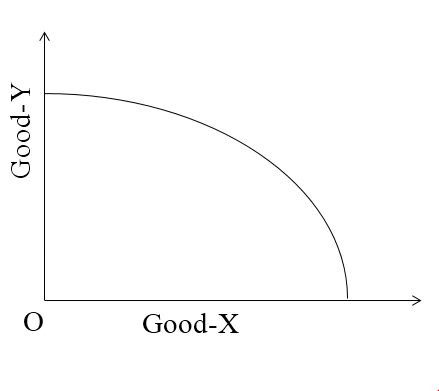
The Concave PPC

II. THE CONVEX PRODUCTION POSSIBILITY CURVE

This is the shape of the Production possibility curve that shows decreasing opportunity cost. This type of PPC implies that all the units of resources are more efficient in the production of one good as shown below.
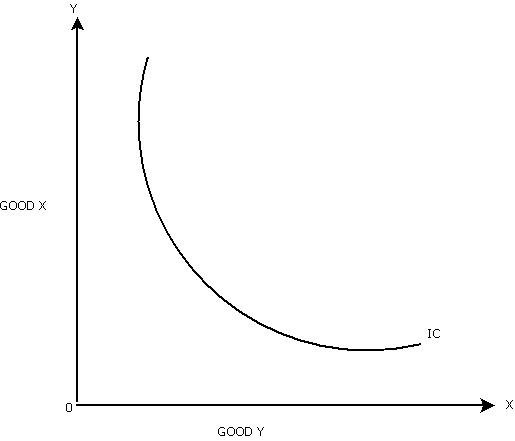
The CONVEX PPC

III. STRAIGHTLINE PRODUCTION POSSIBILITY CURVE

This curve shows constant opportunity cost of resources whic are equally efficient in the alternative. ie Resources are perfectly adaptable as illustrated on the diagram below
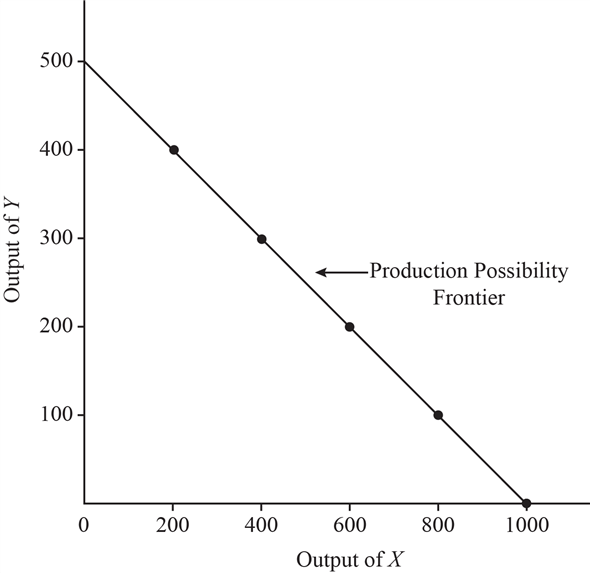
The STRAIGHTLINE PPC

INTERNATIONAL TRADE OR FOREIGN TRADE

International trade can be defined as trade that involves the exchange of goods and services between two or more countries. The theory of international trade is based mainly on the economic principle of comparative cost put forward by David Ricardo. International trade different from internal or home or domestic trade in that internal trade is involved with the exchange of goods and services among the people within a particular country. An example of international trade is Trade between Cameroon and India. An example of internal trade in Cameroon is trade between limbe and Bamenda. The items of internal trade include those goods and services which are being produced to be sold locally within the country without crossing international bouandries. For example Rice, Cars, Clothes etc.

DIFFERENCES BETWEEN INTERNAL TRADE AND INTERNATIONAL TRADE

Internal trade differs from international trade in the following way

Distance: With internal trade, distance is much more shorter than on international trade.

Trade Restrictions : Internal trade is trade without major trade restrictions while internal trade is trade with restrictions such as quotas, tarrifs, embargoes, exchange controls etc.

Currencies: With internal trade, there is the use of only one currency which is considerred as a legal tender while in international trade, there is the use of more than one currency such as the Yen, Dollars, pounds etc

Language Problems: Internal trade is Subjet to a limites number of languages thus little language Problems whereas international trade involves séries of languages which makes communication very difficult.

Foreign Exchange earner: Internal trade is not a foreign exchange earner while international trade is a foreign exchange earner.

Transport cost: Since distances are shorter in internal trade than international trade ans with the principle of the longer the distance the higher the transport cost. Therefore transport cost are higher in international trade than in internal trade.

TYPES OF INTERNATIONAL TRADE

International trade can be broadly divided into two main types which are:

A). Bilateral trade: This refers to trade which takes place between two nations only. For example trade between India and Brazil.

B). Multi-lateral trade: This refers to the exchange of goods and services between more than rwo countries or nations. For example India Can trade with Britain, France, Japan etc. Multi-lateral trade is necessary if the total volume of the World trade is to be raised to its maximum

THEORIES ON INTERNATIONAL TRADE

The theories of international trade are based on the sole idea of specialisation. They include the absolute cost advantage and the comparative cost advantage

I. ABSOLUTE ADVANTAGE : This principle of absolute advantage refers to a situation where a country using the same resources produces a greater output than another country

II. COMPARATIVE COST ADVANTAGE: This simply describes a situation where a country should specialise in the Production of a commodity which has lower opportunity cost than her trading partners.

FACTORS OF PRODUCTION

The Factors of production are various economic resources used in the production of goods and services (output or commodities). They are also known as economic resources or inputs or agents of production. They are classified into Land, capital, Labour and Entrepreneur.

I. LAND: Land refers to all the natural resources availble for production such as rivers water forest etc. Therefore Land is a gift of nature

CHARACTERISTIQUES OF LAND

Land is a gift of nature. This means that Land has no cost of production.

Land is limited in supply (or in quantity). This means that the total amount of natural resources in Land are fixed.

Land is heterogeneous. This means that the quality of Land varies from one place to another. No two pieces of Land can be the same in termes of their fertility, texture, color etc

The reward to Land is rent. Those who owe Land receive a reward known as rent

Land is Subjet to the Law of Diminishing returns. The Law of Diminishing returns states that « as more and more of a variable factor is added to fixed factor, marginal product begins to rise and later on falls ».

Land is geopgraphically Immobile. This characteristic means that Land cannot be tranferred from one place to another. For example. Land in India cannot be transferred to Denmark

II. LABOUR

Labour simple refers to human efforts both mental and Physical directed toward the production of goods and services. Labour receive a reward known as wages or salaries

TYPES OR CLASSIFICATION OF LABOUR

There exist basically two types of Labour. ie Productive and unproductive labour.

1). Productive Labour: This is the type of Labour who earns a reward during the process of Production. For example an economics teacher who earns a salary at the end of the month.

2). Unproductive Labour: This is Labour who doesnot earn a reward during the process of Production. For example a painter painting his own house.

III. CAPITAL

It can be defined as any man-made resource used in the Production of goods and services. Or still it can be defined as wealth set aside for further Production of welth.

TYPES OF CAPITAL

✓ Fixed capital

✓ Specific or sunk capital

✓ Social capital

✓ Circulating working or sunk capital

✓ Human Capital

IV. ENTREPRENEUR

The entrepreneur can be defined as the owner of a business who organise

The Concept of Money

Introduction

Money simply refers to any asset which is generally accepted by people of a particular community (society) for the payment of goods and services and for the settlement of debts. However, money is known as a legal tender in the society where it is being used because by law everybody is compelled to accept it in the payment of goods and services. Examples of money include the Franc for the french co-operation in africa, the US dollars, Euro, Yen, Pound Sterling, Cedi in Ghana etc.

The Barter System of Trade

Definition

Trade by barter can be defined as a form of trading where goods and services are exchanged for other goods and services without the use of money.

Disadvantages or Drawbacks of Trade by barter

The trade by barter had many limitations which included the following:

1. Problem of double coincidence of wants: This refers to a situation whereby the exchange of goods to take place, you need to fine someone who has what you want and wants what you have. This was a very difficult task

2. Bulkiness of some Goods: Some goods by nature were very bulky and heavy thus making it difficult to carry it along.

3. Wastage of time and Efforts: The barter systeme of trade also leads to waste of time and alot of energy because one has to search for someone to exchange goods whoch was not easy

4. Problem of storage: Barter system unlike money doesn’t favours the storage of wealth. It is very difficult to store wealth especially where perishable goods are involved such as tomatoes, bananas, yams etc

5. Discourages lending and borrowning: Lending and borrowning under trade by barter is pratically impossible as there is no unit standard of measurement.

TYPES OR FORMES OF MONEY

Money exist in different formes and include the following

a). Precious metals: Some metals like silver and gold were used as the early form of money. These objects were durable, portable, divisible as required qualitoes of money

b). Commodity Money: Thet Commodity money have an intrinsic value and was commonly used by people as a means of exchange. For example cattle, shells, salt etc

c). Paper money or bank notes: Bank notes or paper money originated from the receipts issued by the goldsmiths to those who deposited precious metals with them for safe keeping. Bank notes can be defined as money printed on papers by the central bank of the country. These banknotes cab either be known as Convertible Bank notes or Incorvertible bank notes

d). Coins: These are shaped pieces of metals bearing an authoritative imprint of the issuing authority which has the power to certify their money value

CHARACTERISTICS OR FEATURES OF GOOD MONEY

I. Generally accepted

II. Divisibility

III. Homogeneity

IV. Portability

V. Stability in value

VI. Relatively Scarce

VII. Malleability.

FUNCTIONS OF MONEY

i. Medium of exchange: This is the most important function of money. By this, people are able to buy and sell goods and services in the society

ii. Unit of account: This function makes it possible for individuals and companies to keep accounting records of all their various transactions

iii. Store of value: Money is a very good store of value because wealth can be stored for the future use in terms of money.

iv. Measure of value: Money can be used to compare and measure the value of goods and services

The Concept of industrialisation

Introduction

Industrialisation is a terme that involves the delibrate government policy to creat many industries in a country irrespective of the sector of production

Definition of Key terms

1. Plant: A plant simply refers to a business establishment. Or still A plant is the actual place where production is being carried out. It could just be a certain branch of a production unit with its own geographical site and output.

2. A Firm: A firm is an administered independent business unit that carry out Production, Construction, or distribution activitied. A firm is usually composed of a group of plants.

3. Industry: This is a terme that consist of a groupe of firms involved in the production and distribution of similar goods or similar seevices. For example: The car manufacture industry, the cement producing industry, the rextile industry etc.

CLASSIFICATION OF INDUSTRIES

Industries can be braodly classified into four main sectors or division.

A. Primary Industries

Primary industries are industries which are involved in the extraction of the various resources or gifts of nature. The output of theses industries are called primary product. For example: Fishing, Hunting, Mining, Farming etc

B. The Secondary Industries or Manufacturing industries

These industries are concerned mainly with the transformation of raw materials into semi-finished and finished products. For example: Manufacturing of tire from rubber latex.

3. Tertiary Industries

They are concerned with the distribution of goods and the provision of services. For example: Banking, Retailing, and Insurance

4. The Quatenary Sector or Industries

This refers to industries with a high rate of advance in technology. An example is the manufacture of computers and cars

The importance (Role) of industrialisation to the economy

a). Creation of employment opportunities: Industrialisation creates employment as new industries are being created and the old ones expanded thereby creating more job opportunities thus reducing unemployment.

b). Increase in the standard of living: Industrialisation makes it possible for the production, distribution and the consumption of more quality goods thus increasing standards of living.

c). Improvement in technical skills: Industrialisation creats good opportunities for labour to acquire more training and skills which leads to the acquisition of new and better ideas

d). Increase in Infrastructure: Industries tend to improve on the road structure and other communication infrastructure to help evacuate the manufactured goods to the various consumers

e). Increase in government revenue: The government gets much money from industries through the imposition of taxes

Demand and its Elasticity

Introduction

Definition of Demand

Demand refers to the quantity of good or service a consumer is willing and able to pay. Or still demand is the desire to obtain a particular commodity backed by the ability to pay for it ie Purchasing power. It should however be noted that demand must always be backed by the purchasing power of the consumer to be known as Effective demand. Effective demand is demand back by the purchasing power. Demand should not be confused with mere desire of something which is not backed by price

The Demand Schedule

The demand schedule is a table that represents the various quantities and prices of goods that a consumer is willing and able to buy.

The demand curve

This is simply the graphical representations of the demand schedule. The demand curve slopes down from left to right which indicates that « the higher the price, the lower the quantity demanded ceteris paribus(everything being equal or everything reamining constant)

The Elasticity of Demand

The elasticity of demand refers to the degre of responsiveness of quantity demanded to changes in the price of the commodity, the price of other goods etc. It can also be defined as the rate at which quantity demanded changes as a result of changes in prices. There exist three main types of elasticity of demand as seen below.

Types of elasticities of demand

1. Price elasticity of demand (PED): It refers to the degree of responsivesness of quantity demanded to changes in prices.

2. Income elasticity of demand(YED): It refers to the degree of responsiveness of quantity demanded as a result of changes in the level of consumers income

3. Cross elasticity of demand (XED): It refers to the degree of responsiveness of quantity demanded of a particular good say good A to change as a result of change in the price of another good say Good B.

Présentation personnelle (exemple d’article)

Voici un exemple d’article, publié initialement dans le cadre de la Blogging University. Inscrivez-vous à l’un de nos dix programmes et lancez votre blog.

Vous allez publier un article aujourd’hui. Ne vous inquiétez pas pour l’apparence de votre blog. Ne vous inquiétez pas si vous ne lui avez pas encore donné de nom ou si vous vous sentez dépassé. Cliquez simplement sur le bouton « Nouvel article » et dites-nous pourquoi vous êtes ici.

Quel est votre objectif ?

  • Vos nouveaux lecteurs ont besoin de contexte. De quoi parlerez-vous ? Pourquoi devraient-ils lire votre blog ?
  • Cela vous aidera à vous concentrer sur vos idées à propos de votre blog et sur la façon dont vous souhaitez le développer.

L’article peut être court ou long, contenir une introduction personnelle sur votre vie, décrire la mission de votre blog, présenter un manifeste pour l’avenir ou énoncer simplement vos sujets de publication.

Pour vous aider à commencer, voici quelques questions :

  • Pourquoi créez-vous un blog public au lieu de tenir un journal personnel ?
  • Quels seront les thèmes que vous aborderez ?
  • Quelle est la cible privilégiée de votre blog ?
  • Si votre blog passe la première année avec succès, qu’espérez-vous avoir accompli ?

Répondre à ces questions ne vous enferme pas définitivement dans une voie. Ce qui est magnifique avec les blogs, c’est qu’ils sont en constante évolution au fur et à mesure de vos apprentissages, de votre développement et des interactions avec autrui. Il est toutefois opportun de savoir où et pourquoi vous vous lancez. L’articulation de vos objectifs peut simplement contribuer à apporter de nouvelles idées d’articles.

Vous ne savez pas trop comment commencer ? Écrivez simplement la première chose qui vous passe par la tête. Anne Lamott, auteur d’un excellent livre sur le processus d’écriture, affirme qu’il est nécessaire de s’autoriser un « premier jet bordélique ». C’est un enseignement essentiel : commencez par écrire, vous vous occuperez de retoucher votre texte plus tard.

Une fois que vous êtes prêt à publier, attribuez à votre article trois à cinq étiquettes qui décrivent son sujet : littérature, photographie, fiction, parentalité, alimentation, voitures, films, sports, etc. Ces étiquettes aideront les internautes intéressés par ces sujets à vous trouver dans le Lecteur. Veillez à ce que l’une de ces étiquettes soit « zerotohero », afin que les nouveaux blogueurs puissent vous trouver également.

Présentation personnelle (exemple d’article)

Voici un exemple d’article, publié initialement dans le cadre de la Blogging University. Inscrivez-vous à l’un de nos dix programmes et lancez votre blog.

Vous allez publier un article aujourd’hui. Ne vous inquiétez pas pour l’apparence de votre blog. Ne vous inquiétez pas si vous ne lui avez pas encore donné de nom ou si vous vous sentez dépassé. Cliquez simplement sur le bouton « Nouvel article » et dites-nous pourquoi vous êtes ici.

Quel est votre objectif ?

  • Vos nouveaux lecteurs ont besoin de contexte. De quoi parlerez-vous ? Pourquoi devraient-ils lire votre blog ?
  • Cela vous aidera à vous concentrer sur vos idées à propos de votre blog et sur la façon dont vous souhaitez le développer.

L’article peut être court ou long, contenir une introduction personnelle sur votre vie, décrire la mission de votre blog, présenter un manifeste pour l’avenir ou énoncer simplement vos sujets de publication.

Pour vous aider à commencer, voici quelques questions :

  • Pourquoi créez-vous un blog public au lieu de tenir un journal personnel ?
  • Quels seront les thèmes que vous aborderez ?
  • Quelle est la cible privilégiée de votre blog ?
  • Si votre blog passe la première année avec succès, qu’espérez-vous avoir accompli ?

Répondre à ces questions ne vous enferme pas définitivement dans une voie. Ce qui est magnifique avec les blogs, c’est qu’ils sont en constante évolution au fur et à mesure de vos apprentissages, de votre développement et des interactions avec autrui. Il est toutefois opportun de savoir où et pourquoi vous vous lancez. L’articulation de vos objectifs peut simplement contribuer à apporter de nouvelles idées d’articles.

Vous ne savez pas trop comment commencer ? Écrivez simplement la première chose qui vous passe par la tête. Anne Lamott, auteur d’un excellent livre sur le processus d’écriture, affirme qu’il est nécessaire de s’autoriser un « premier jet bordélique ». C’est un enseignement essentiel : commencez par écrire, vous vous occuperez de retoucher votre texte plus tard.

Une fois que vous êtes prêt à publier, attribuez à votre article trois à cinq étiquettes qui décrivent son sujet : littérature, photographie, fiction, parentalité, alimentation, voitures, films, sports, etc. Ces étiquettes aideront les internautes intéressés par ces sujets à vous trouver dans le Lecteur. Veillez à ce que l’une de ces étiquettes soit « zerotohero », afin que les nouveaux blogueurs puissent vous trouver également.

Présentation personnelle (exemple d’article)

Voici un exemple d’article, publié initialement dans le cadre de la Blogging University. Inscrivez-vous à l’un de nos dix programmes et lancez votre blog.

Vous allez publier un article aujourd’hui. Ne vous inquiétez pas pour l’apparence de votre blog. Ne vous inquiétez pas si vous ne lui avez pas encore donné de nom ou si vous vous sentez dépassé. Cliquez simplement sur le bouton « Nouvel article » et dites-nous pourquoi vous êtes ici.

Quel est votre objectif ?

  • Vos nouveaux lecteurs ont besoin de contexte. De quoi parlerez-vous ? Pourquoi devraient-ils lire votre blog ?
  • Cela vous aidera à vous concentrer sur vos idées à propos de votre blog et sur la façon dont vous souhaitez le développer.

L’article peut être court ou long, contenir une introduction personnelle sur votre vie, décrire la mission de votre blog, présenter un manifeste pour l’avenir ou énoncer simplement vos sujets de publication.

Pour vous aider à commencer, voici quelques questions :

  • Pourquoi créez-vous un blog public au lieu de tenir un journal personnel ?
  • Quels seront les thèmes que vous aborderez ?
  • Quelle est la cible privilégiée de votre blog ?
  • Si votre blog passe la première année avec succès, qu’espérez-vous avoir accompli ?

Répondre à ces questions ne vous enferme pas définitivement dans une voie. Ce qui est magnifique avec les blogs, c’est qu’ils sont en constante évolution au fur et à mesure de vos apprentissages, de votre développement et des interactions avec autrui. Il est toutefois opportun de savoir où et pourquoi vous vous lancez. L’articulation de vos objectifs peut simplement contribuer à apporter de nouvelles idées d’articles.

Vous ne savez pas trop comment commencer ? Écrivez simplement la première chose qui vous passe par la tête. Anne Lamott, auteur d’un excellent livre sur le processus d’écriture, affirme qu’il est nécessaire de s’autoriser un « premier jet bordélique ». C’est un enseignement essentiel : commencez par écrire, vous vous occuperez de retoucher votre texte plus tard.

Une fois que vous êtes prêt à publier, attribuez à votre article trois à cinq étiquettes qui décrivent son sujet : littérature, photographie, fiction, parentalité, alimentation, voitures, films, sports, etc. Ces étiquettes aideront les internautes intéressés par ces sujets à vous trouver dans le Lecteur. Veillez à ce que l’une de ces étiquettes soit « zerotohero », afin que les nouveaux blogueurs puissent vous trouver également.